An also synonym is a word or phrase that expresses the idea of addition, meaning something extra, something more, or another point to consider. Common synonyms for also include too, as well, additionally, furthermore, moreover, besides, and in addition. Although these expressions share a similar meaning, they do not always fit the same sentence. For example, “She also teaches English” can become “She teaches English too,” while “Additionally, she teaches English” sounds more formal.
Learning synonyms for also can help you avoid repetitive wording in essays, emails, conversations, blog posts, and professional documents. The best alternative depends on your sentence structure, tone, and the relationship between your ideas.
Test Your Vocabulary Instantly
100+ commonly confused English words, instant right/wrong feedback — see your score in minutes.
What Does Also Mean?
The word also means in addition, too, or as well. People use it to add information, mention another action, or show that a statement applies to more than one person or thing. An also synonym performs a similar function while giving you more options for expressing the same idea.
For example, if your friend says, “I enjoy reading,” you might reply, “I also enjoy reading.” You could express the same idea by saying, “I enjoy reading too.”
Consider these additional examples:
- My sister also plays the piano.
- We visited the museum and saw the art gallery as well.
- The new software is affordable and easy to use.
- Additionally, the school offers free tutoring.
Each sentence adds information, but the wording creates a slightly different rhythm or level of formality. Understanding these differences helps you select an appropriate synonym for also instead of replacing the word without considering the sentence.
35+ Synonyms for Also With Meanings
The following also synonyms cover everyday conversations, academic writing, professional communication, and formal reports. Some work best at the end of a sentence, while others introduce an additional point.
Common Also Synonyms for Everyday English
These alternatives sound natural in conversations, messages, and informal writing.
Also Synonym: 35+ Words
Explore useful alternatives to “also,” understand their meanings, and choose the right word for every sentence.
Word at a glance
What does “also” mean?
Also means “in addition,” “too,” or “as well.” We use it to add another fact, idea, action, or person. The best synonym depends on the sentence and how formal you want to sound.
Quick meaning
Popular synonyms for “also”
Used to add similar information, often at the end of a sentence.
EverydayA natural way to say that something applies in addition.
EverydayAdds another point, especially in writing or presentations.
FormalIntroduces extra information in reports, essays, and explanations.
FormalAdds a supporting point to an argument or explanation.
AcademicAdds a point that strengthens the previous statement.
AcademicIntroduces another reason or point; tone depends on context.
ConversationalShows that one thing comes together with another.
GeneralShows that a similar thing is true in another case.
ComparisonExample in context
Original: “Maya plays the guitar. She also sings.”
Alternative: “Maya plays the guitar. She sings too.”
More formal: “Maya plays the guitar. In addition, she sings.”
Writing tip: “Too” and “as well” work well in everyday conversation. “Furthermore,” “moreover,” and “additionally” often suit formal writing, but they may sound stiff in casual speech.
Choose the best synonym
Quick practice · Question 1 of 1
Which word best completes this formal sentence?
“_____ , the study found a second cause.”
Choose an answer to check your understanding.
This conversational expression adds another fact, often one that strengthens a point.
Example: The bus was late, and on top of that, it started raining.
Formal Also Synonyms for Academic and Professional Writing
When writing an essay, report, or business email, a more formal also synonym can make the connection between ideas clearer.
8. Additionally
Additionally introduces another related point. It works particularly well at the beginning of a sentence.
Example: Additionally, the study examines how sleep affects concentration.
9. Furthermore
Furthermore adds information that supports or develops a previous statement.
Example: The course improves writing skills. Furthermore, it helps students build confidence.
10. Moreover
Moreover introduces an additional point that often strengthens an argument.
Example: The proposal reduces costs. Moreover, it improves the quality of customer service.
11. In addition to
In addition to introduces an extra person, thing, activity, or consideration. It is usually followed by a noun or an -ing form.
Example: In addition to teaching English, she writes educational articles.
12. What is more
What is more adds another point, often one that the writer considers especially relevant.
Example: The apartment is close to the university. What is more, it includes internet access.
13. Equally important
Equally important introduces another point that deserves similar attention.
Example: The team must meet its deadlines. Equally important, it must maintain accurate records.
14. Not only that
Not only that adds another fact, often in a conversational or persuasive style.
Example: The phone has a clear display. Not only that, it offers excellent battery life.
15. Likewise
Likewise means in a similar way or in the same manner. It does not simply mean also in every context.
Example: The first teacher encouraged independent reading. Likewise, the second teacher helped students explore books on their own.
Also Synonyms That Emphasize Extra Information
Some expressions are useful when you want to show that a person, action, or item joins something already mentioned.
16. Additionally to
This phrase is generally less natural than “in addition to” in standard English. Use “in addition to” when introducing an extra item or activity.
Example: In addition to her regular duties, she manages the school library.
17. Together with
Together with means accompanied by or combined with another person or thing.
Example: The manager, together with her assistants, prepared the report.
18. Coupled with
Coupled with introduces another factor that combines with the first one to produce a result.
Example: Regular practice, coupled with helpful feedback, can improve writing.
19. As well as
As well as adds another person, activity, or thing to the sentence.
Example: He enjoys football as well as cricket.
20. Including
Including identifies something that forms part of a larger group or list.
Example: The workshop covers several topics, including grammar and pronunciation.
21. Not to mention
Not to mention introduces another relevant point, often one that makes the previous statement even stronger.
Example: The journey was long, not to mention expensive.
22. And
And is one of the simplest ways to connect two related ideas.
Example: She bought notebooks and pens.
Additional Alternatives for Specific Contexts
The following expressions can replace also in certain sentences, but their meanings depend on context.
Also Synonyms: 23–35
Explore more ways to add information, connect similar ideas, and make your English sound natural and clear.
Explore the Synonyms
Similarly
Shows that another situation has a similar feature or follows a comparable pattern.
Correspondingly
Indicates a related change or a connection between two things.
In the Same Way
Introduces an action or situation that follows a similar pattern.
By the Same Token
Adds a related point based on the same reasoning or principle.
Further
Means additional or more when used before a noun. It can also refer to making progress.
Over and Above
Means in addition to something already included, expected, or required.
Beyond That
Introduces another point or consideration after the first one.
Added to That
Introduces another fact or reason, often in everyday conversation.
To Boot
Means in addition, usually in informal English and often with extra emphasis.
Alongside
Means next to or together with. It can show that two things exist or happen together.
Supplementing
Means adding something that improves or completes something else. It is not a direct substitute for “also” in every sentence.
Additionally to This
This wording sounds awkward in standard English. Use “in addition to this” or “additionally” instead.
Further to That
A relatively formal expression used to refer to a previous point or add a related detail. It is especially common in British business communication.
Further to that is a formal expression used to introduce additional information, particularly in some varieties of professional English.
Example: Further to that, the manager requested a revised budget.
Best Also Synonyms for Different Situations
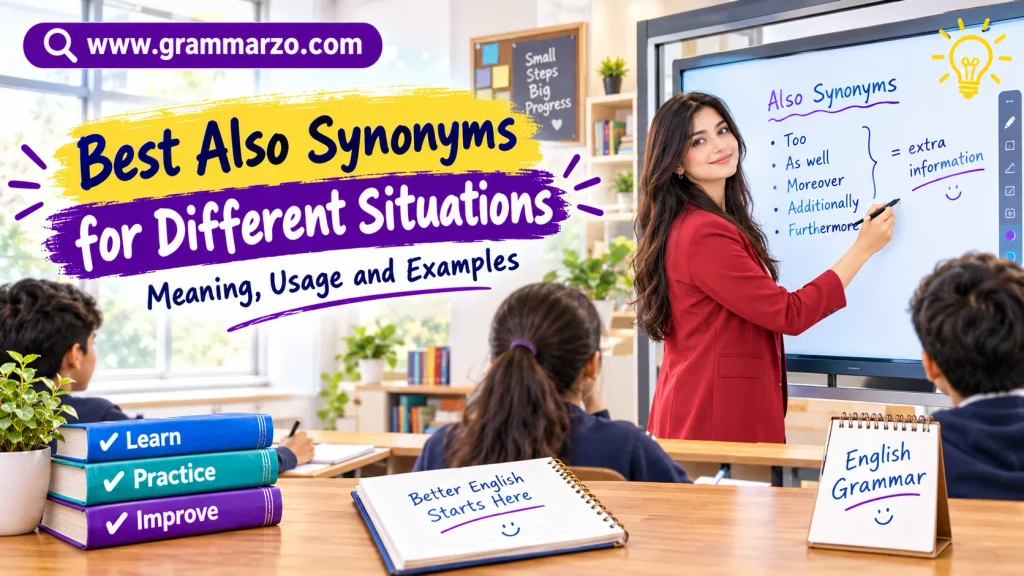
Choosing the right also synonym depends on the purpose of your writing. A casual message, a school essay, and a formal report may require different expressions.
Also Synonyms for Everyday Conversations
In daily conversation, short and familiar words usually sound most natural. Too, as well, plus, and besides are useful choices.
Examples:
- “I also want some tea.” → “I want some tea too.”
- “She plays the guitar also.” → “She plays the guitar as well.”
- “Besides studying, he works part-time.”
- “The movie was funny, plus the ending was surprising.”
When speaking with friends, you usually do not need formal transitions such as furthermore or moreover. Those expressions may sound unnecessarily formal in a simple conversation.
Also Synonyms for Essays and School Assignments
Academic writing benefits from clear transitions that connect related ideas. Additionally, furthermore, moreover, and in addition are useful when introducing supporting information.
Example:
“Reading improves vocabulary. Furthermore, it helps students understand sentence structure.”
Another example:
“Regular exercise supports physical health. Additionally, it may help people manage everyday stress.”
Use these transitions only when they genuinely connect the ideas. Adding a formal word at the start of every paragraph can make an essay sound repetitive.
Also Synonyms for Emails and Business Reports
Professional writing often needs precise, neutral language. Additionally, in addition to, and furthermore can help you present extra information without making the message sound casual.
Examples:
- Additionally, please attach the updated invoice.
- In addition to the monthly report, we need the latest sales figures.
- Furthermore, the team recommends reviewing the schedule next week.
For a short email, “Also, please send the updated file” may be perfectly clear. A more formal alternative is not always better; clarity and natural wording matter most.
Also Synonyms for Social Media and Text Messages
Online conversations usually favor short expressions that readers can understand quickly. Too, plus, and as well are common options for informal posts and messages.
Examples:
- “I loved the new video too!”
- “The outfit looks great, plus it is comfortable.”
- “I shared the photos as well.”
- “We should try that restaurant too.”
On platforms such as Instagram, Snapchat, and TikTok, writers may also use “and” to connect short thoughts naturally. Formal transitions can still work in educational posts, professional captions, or detailed explanations.
Also vs. Too vs. As Well
Also, too, and as well have similar meanings, but their usual positions in a sentence differ.
How to Use Also
Also usually appears before the main verb, but it generally follows the verb “be” and the first auxiliary verb.
Examples:
- I also enjoy cooking.
- She is also a talented singer.
- They have also completed the assignment.
This placement makes also convenient when you want to add information without changing the overall sentence structure.
How to Use Too
Too commonly appears at the end of a positive sentence or clause.
Examples:
- I enjoy cooking too.
- She is a talented singer too.
- They completed the assignment too.
Too can also mean excessively, as in “The soup is too hot.” In that sentence, it does not mean also, so context matters.
How to Use As Well
As well usually appears at the end of a clause and often sounds natural in everyday English.
Examples:
- I enjoy cooking as well.
- She is a talented singer as well.
- They completed the assignment as well.
In many positive sentences, all three expressions work. The main difference is their natural placement and the rhythm they create.
How to Use Also Synonyms Without Repetition
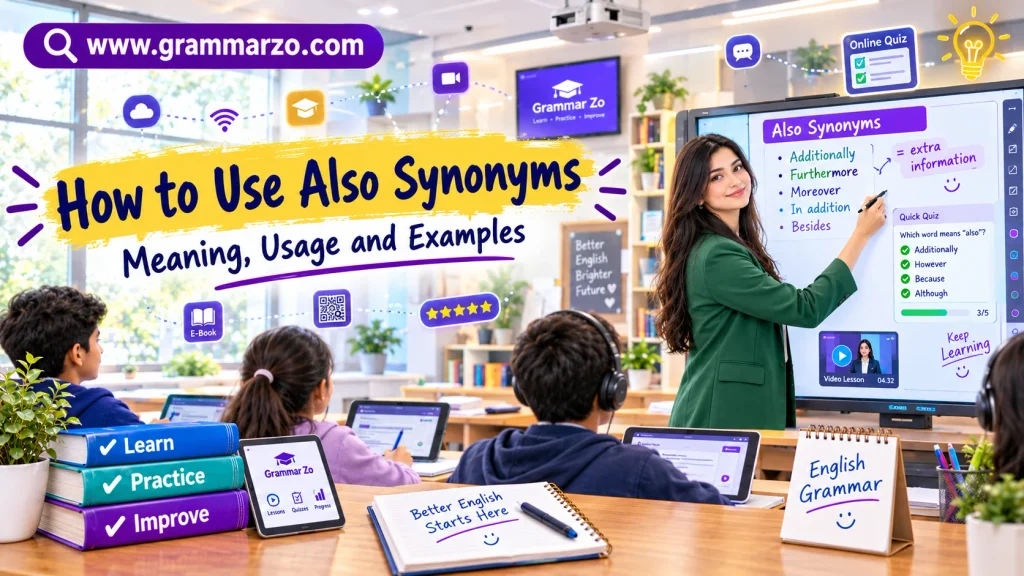
Repeating also in every sentence can make a paragraph sound mechanical. You can improve the flow by choosing a transition that matches the relationship between your ideas.
Replace Repeated Words With Natural Alternatives
Consider this paragraph:
“The school offers English lessons. It also offers computer classes. It also provides career guidance.”
A smoother version would be:
“The school offers English lessons and computer classes. Additionally, students can receive career guidance.”
The revised version combines related information and uses one transition where it adds value. You do not need to replace every instance of also; sometimes, changing the sentence structure works better.
Match the Transition to the Meaning
Different expressions perform different jobs:
- Use furthermore when adding support to a previous argument.
- Use moreover when introducing an additional point that strengthens your case.
- Use similarly when comparing related situations.
- Use too or as well in natural conversation.
- Use in addition to before a noun or an -ing form.
- Use along with when describing something that accompanies another item.
For example, “In addition to reading, she enjoys writing” is natural. “Furthermore reading, she enjoys writing” is not a correct replacement because furthermore does not work in that grammatical structure.
Avoid Overusing Formal Transitions
A paragraph does not need a transition at the beginning of every sentence. Too many expressions such as moreover, furthermore, and additionally can distract readers from your message.
Instead, combine related points, use pronouns where the reference is clear, and let the ideas connect naturally. A well-written paragraph values clarity more than the number of synonyms it contains.
Common Mistakes When Choosing an Also Synonym
Although many words can express addition, some have different grammatical roles or meanings.
Using Besides When You Mean Only Also
Besides can mean in addition to, but it can also introduce a reason or an argument.
For example, “Besides English, she studies French” adds another subject. However, “Besides, we do not have enough time” means something closer to “in any case” or “another reason is.”
Choose the expression that matches your intended meaning.
Confusing Similarly With Additionally
Similarly compares two things that share a feature. Additionally simply introduces extra information.
For example:
“Ali studies every evening. Similarly, Sara follows a regular study routine.”
The sentence compares two habits. If you wrote “Additionally, Sara follows a regular study routine,” you would simply add another fact about Sara.
Using In Addition to With the Wrong Structure
In addition to is normally followed by a noun, pronoun, or gerund.
Correct: In addition to teaching, she writes books.
Incorrect: In addition to she teaches, she writes books.
A better version is: In addition to teaching, she writes books. Alternatively, write: She teaches, and she also writes books.
Assuming Every Synonym Fits Every Sentence
Some alternatives require changes to the sentence structure.
For example, “He also manages the team” can become “He manages the team too.” However, replacing also with “in addition to” would require a different construction.
Always check the grammar after changing the word.
Frequently Asked Questions
What is the best synonym for also?
Too, as well, additionally, furthermore, and in addition are useful synonyms for also. Too and as well work naturally in conversation, while additionally and furthermore often suit formal writing.
What is a simple word for also?
Too is one of the simplest alternatives. For example, “I also like coffee” can become “I like coffee too.”
What is a formal synonym for also?
Additionally, furthermore, moreover, and in addition are suitable formal alternatives. The best option depends on whether you are adding a fact, strengthening an argument, or introducing a related point.
Can I use besides instead of also?
Yes, in some sentences. “Besides English, she studies French” means that she studies French in addition to English. However, besides can also introduce a reason, so it does not replace also in every context.
Is also the same as as well?
Also and as well often communicate the same idea, but their usual positions differ. Also generally appears before the main verb, while as well commonly appears at the end of a clause.
What is another word for also in an essay?
Additionally, furthermore, moreover, and in addition are useful in essays. Use them to connect related points, but avoid placing a transition at the beginning of every sentence.
What can I use instead of also in an email?
You can use additionally, furthermore, in addition, too, or as well, depending on the tone. For a simple request, “Also, please send the attachment” is clear and professional enough in many situations.
How can I avoid repeating also in a paragraph?
Combine related sentences, use too or as well where appropriate, and choose transitions such as additionally or furthermore when they clarify the connection between ideas. You can also restructure a sentence instead of inserting another synonym.
Final Thoughts
An also synonym helps you add information without repeating the same word throughout your writing. Useful alternatives include too, as well, besides, additionally, furthermore, moreover, in addition, and along with.
For everyday conversations, choose familiar expressions such as too and as well. For essays and professional reports, consider additionally, furthermore, or in addition. When comparing ideas, similarly may be more accurate than also.
The key is to choose a word that fits your meaning, grammar, and tone. With the right alternative, your writing can sound more natural, varied, and clear.