The word masculine describes qualities, characteristics, expressions, or grammatical forms traditionally associated with men or boys. In English grammar, it can also refer to a gender category used to describe male people or certain gendered nouns in other languages. Understanding this term helps you choose appropriate words, describe people accurately, and recognize gender-related language.
The meaning of masculine depends on the context. It can describe someone’s appearance, personality, clothing, behavior, voice, or writing style. It also appears in grammar, literature, fashion, and everyday conversations.
Test Your Vocabulary Instantly
100+ commonly confused English words, instant right/wrong feedback — see your score in minutes.
What Does Masculine Mean?
The term masculine refers to qualities or characteristics traditionally associated with men. People commonly use it when discussing appearance, personality, clothing, communication, or cultural expectations about gender.
For example, a deep voice, broad shoulders, a beard, or a traditionally men’s clothing style may be described as masculine. However, these characteristics do not belong exclusively to men. People of any gender can display them.
Consider these examples:
- His deep voice sounds masculine.
- She prefers a masculine clothing style.
- The actor has a strong, masculine appearance.
- The designer created a masculine interior for the office.
- His confident attitude is often described as masculine.
The word can have different meanings depending on the situation. In fashion, it may describe clothing with traditionally men’s styling. Also, In personality descriptions, it may refer to traits such as assertiveness or confidence. In grammar, it identifies a gender category in certain languages.
It is also important to understand that traditional gender associations are not universal rules. People have different personalities, appearances, and preferences regardless of gender.
Masculine in English Grammar
In English grammar, masculine is a gender category associated with male people and certain pronouns. Modern English uses grammatical gender less extensively than languages such as French, Spanish, and German.
The most familiar examples are personal pronouns.
Masculine Pronouns
English commonly uses the following pronouns when referring to a male person:
| Pronoun | Grammatical role | Example |
|---|---|---|
| He | Subject | He works in a hospital. |
| Him | Object | I called him yesterday. |
| His | Possessive determiner | His car is outside. |
| His | Possessive pronoun | The blue jacket is his. |
| Himself | Reflexive | He introduced himself. |
These pronouns help readers understand who performs an action, receives an action, or owns something.
For example:
- David is my brother. He lives in London.
- I met Daniel and spoke with him.
- That is his new bicycle.
- The decision was his.
- Michael prepared himself for the interview.
When referring to someone whose gender is unknown or irrelevant, singular they is also widely used in modern English.
Masculine Nouns
Some nouns directly identify male people or animals.
Examples include:
- Man
- Boy
- Father
- Brother
- Husband
- King
- Prince
- Uncle
- Actor
- Waiter
These words identify male individuals or traditionally gendered roles.
However, many English nouns are gender-neutral. Words such as teacher, doctor, student, neighbor, and friend do not indicate whether someone is male or female.
For instance, the word doctor can describe a man or a woman. You do not need a separate masculine noun to identify a male doctor.
Masculine and Feminine: Key Differences
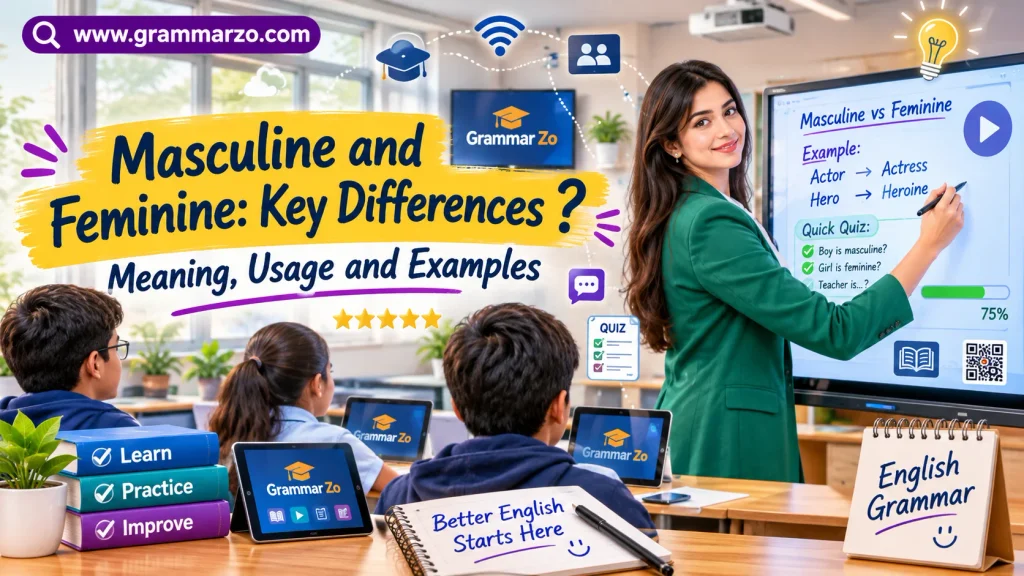
Masculine and feminine are traditionally used as contrasting gender-related terms. The first generally refers to qualities or grammatical forms associated with men, while the second refers to qualities or forms associated with women.
Their meanings depend on the subject being discussed.
Comparison Table
| Masculine | Feminine |
|---|---|
| Man | Woman |
| Boy | Girl |
| Father | Mother |
| Brother | Sister |
| Husband | Wife |
| King | Queen |
| Prince | Princess |
| Uncle | Aunt |
| Bull | Cow |
| Rooster | Hen |
Some words have completely different forms, while others use different endings.
For example, prince and princess refer to male and female members of royalty. Similarly, actor and actress have traditionally been used for male and female performers, although actor is now commonly used for people of any gender.
Examples in Everyday Sentences
- My brother is a teacher, and my sister is a doctor.
- The king welcomed the queen.
- Her father and mother attended the ceremony.
- The prince spoke to the princess.
These examples demonstrate traditional gender distinctions in English vocabulary. They do not mean that every person must fit into these categories.
Masculine Traits and Personality Characteristics
The term is frequently used to describe personality traits that cultures have traditionally associated with men. These associations can vary across societies, families, and generations.
Common examples include confidence, assertiveness, independence, courage, and a competitive attitude.
However, these characteristics are not exclusive to men. Women and people of other genders can demonstrate exactly the same qualities.
Commonly Associated Characteristics
Confidence: A confident person trusts their abilities and can express opinions without unnecessary hesitation.
Assertiveness: An assertive individual communicates their needs clearly while respecting other people.
Independence: This quality describes someone who can make decisions and handle responsibilities without depending excessively on others.
Courage: Courage means facing difficulties or uncomfortable situations despite fear.
Responsibility: A responsible person accepts the consequences of their decisions and takes care of important duties.
Examples in Conversations
Consider the following situations:
At work:
“Ahmed handled the difficult meeting with confidence. His colleagues admired his assertive communication.”
During a family discussion:
“My father always encouraged us to become independent and responsible.”
While discussing a character in a movie:
“The character displays courage and determination throughout the story.”
These examples show how people discuss traditionally gender-associated traits without suggesting that only men can possess them.
Masculine Appearance and Physical Features
In fashion, entertainment, and everyday conversations, the word can describe a person’s physical presentation or overall appearance.
Some features are traditionally associated with men’s appearance, although individual differences are natural.
Common Examples
People may use this description when discussing:
- Facial hair, such as beards and mustaches.
- Broad shoulders.
- A deep or low-pitched voice.
- Short hairstyles traditionally marketed toward men.
- Clothing with traditionally men’s cuts and designs.
- Strong or angular facial features.
For example, someone might say:
“His beard and short haircut give him a masculine appearance.”
Another person might say:
“She has a masculine style because she prefers oversized jackets and loose-fitting trousers.”
Neither description determines someone’s identity or personality. Appearance and gender identity are different things.
Masculine Clothing and Fashion Styles
Fashion is another area where people frequently use this term. It generally describes clothing, accessories, colors, and designs traditionally associated with men’s fashion.
A person does not have to be male to wear these styles. Clothing preferences are personal, and fashion regularly combines elements from different traditional categories.
Popular Clothing Examples
Masculine clothing styles commonly include tailored suits, structured blazers, loose-fitting trousers, oversized shirts, leather jackets, and denim jackets. Formal shoes, boots, and sneakers also complement these outfits. Neutral colors such as black, gray, navy, and brown are frequently used to create a clean and classic appearance. Simple watches and minimalist accessories add subtle details without making the overall outfit look overly complicated.
What Does Masculine Style Mean?
A masculine style usually focuses on structured shapes, practical designs, and traditionally men’s clothing elements.
For example, a woman wearing a dark oversized blazer, straight-leg trousers, and leather boots might describe her outfit as masculine-inspired.
Similarly, a man wearing a fitted suit with a structured jacket might choose this style for a formal event.
Fashion descriptions are flexible. Modern clothing trends frequently mix traditionally masculine and feminine elements.
Masculine Energy: Meaning and Common Usage
The phrase masculine energy appears in conversations about personality, relationships, self-development, and social expectations.
People often use it to describe qualities such as leadership, decisiveness, confidence, ambition, and taking initiative.
However, masculine energy is a cultural or self-development expression, not a scientifically established type of energy.
Examples of Masculine Energy
Someone might use the phrase to describe a person who:
- Takes initiative when solving problems.
- Makes decisions confidently.
- Accepts responsibility.
- Sets clear personal goals.
- Approaches challenges with determination.
- Demonstrates leadership in difficult situations.
For example:
“People appreciate his masculine energy because he remains calm and decisive under pressure.”
In relationship discussions, someone might say:
“I like a partner who shows confidence, emotional maturity, and responsibility.”
The phrase can also appear on Instagram, TikTok, and other social platforms. Its meaning may change depending on the creator or discussion.
It should not be treated as a strict rule for how men or women must behave. Emotional sensitivity, kindness, cooperation, and independence are valuable qualities for everyone.
Masculine Words in Other Languages
Grammatical gender is more noticeable in several languages than it is in English.
In languages such as Spanish, French, German, and Italian, nouns may have masculine or feminine grammatical forms. These classifications do not always describe the actual gender of a person or object.
Spanish Examples
Spanish uses masculine and feminine grammatical categories.
| Masculine | Feminine | English meaning |
|---|---|---|
| El niño | La niña | The boy / The girl |
| El gato | La gata | The male cat / The female cat |
| El amigo | La amiga | The male friend / The female friend |
| El profesor | La profesora | The male teacher / The female teacher |
For example:
- El niño juega en el parque. (The boy plays in the park.)
- La niña lee un libro. (The girl reads a book.)
The articles el and la help identify the grammatical gender of the nouns.
French Examples
French also uses grammatical gender.
| Masculine | Feminine | Meaning |
|---|---|---|
| Le garçon | La fille | Boy / Girl |
| Le père | La mère | Father / Mother |
| Le frère | La sœur | Brother / Sister |
| Le professeur | La professeure | Teacher |
Unlike English, French often requires articles and adjectives to agree with the grammatical gender of nouns.
This is why learning gender categories is useful when studying languages with grammatical gender.
Masculine in Literature and Writing
Writers use the term when discussing characters, descriptions, symbolism, and traditional gender roles.
In literature, a character might display qualities that readers traditionally associate with masculinity, such as courage, ambition, physical strength, or leadership.
However, a well-developed character does not need to follow traditional expectations.
Examples in Literature
A writer might describe a fictional character as having a masculine personality because he takes responsibility, makes difficult decisions, and protects people he cares about.
Another writer might describe a female character with traditionally masculine characteristics because she is independent, ambitious, and comfortable taking leadership roles.
For example:
“The novel presents a strong female character who challenges traditional expectations about gender and leadership.”
Such descriptions help readers understand how authors develop characters and explore cultural expectations.
Common Synonyms and Related Words
Several words can replace this term in particular situations, but their meanings are not always identical. The best alternative depends on whether you are discussing appearance, personality, fashion, or grammar.
| Word | Meaning | Example |
|---|---|---|
| Manly | Traditionally associated with men | He has a manly voice. |
| Virile | Traditionally associated with male strength or vitality | The character has a virile presence. |
| Malespecific | Related specifically to males | The study examined male-specific characteristics. |
| Strong | Showing physical or mental strength | She has a strong personality. |
| Assertive | Confident in expressing opinions | He is an assertive speaker. |
| Rugged | Having a rough, traditionally masculine appearance | He has a rugged look. |
| Masculine-presenting | Having an appearance associated with masculinity | The character is masculine-presenting. |
Some alternatives are more appropriate in certain situations.
For example, rugged usually describes physical appearance, while assertive describes communication or behavior. Neither word is a perfect replacement in every sentence.
Common Mistakes When Using the Word
Although the meaning is straightforward, people sometimes misunderstand how to use the term in writing and conversation.
Treating Traditional Traits as Universal Rules
One common mistake is assuming that all men must be confident, physically strong, or emotionally reserved.
These are cultural expectations, not universal characteristics. People have different personalities regardless of gender.
Confusing Grammatical Gender With Biological Sex
Grammatical gender is a language classification. In some languages, objects have masculine or feminine grammatical forms even though they do not have biological sex.
For example, the Spanish word libro (book) is grammatically masculine. A book itself is not male.
Using Gendered Job Titles Unnecessarily
Older English vocabulary includes terms such as policeman, chairman, and fireman. Modern English often uses gender-neutral alternatives:
- Police officer instead of policeman.
- Chairperson or chair instead of chairman.
- Firefighter instead of fireman.
These alternatives can make writing more inclusive and suitable for a wider audience.
Assuming Clothing Determines Identity
A person’s clothing does not automatically indicate their gender identity. Someone can prefer traditionally men’s clothing without identifying as a man.
Frequently Asked Questions
What Is the Simple Meaning of Masculine?
It describes qualities, characteristics, appearances, or grammatical forms traditionally associated with men and boys. The meaning changes depending on the context.
What Is the Opposite of Masculine?
The traditional opposite is feminine. Masculine generally relates to characteristics associated with men, while feminine relates to characteristics traditionally associated with women.
Can a Woman Have Masculine Traits?
Yes. A woman can demonstrate confidence, independence, assertiveness, courage, and other characteristics traditionally associated with men. These qualities are not limited to one gender.
Is Masculine the Same as Male?
No. Male generally refers to biological sex or a male individual, while masculine describes qualities, expressions, styles, or grammatical categories associated with men.
What Does Masculine Mean in Texting?
In texting, people commonly use the word to describe someone’s appearance, clothing, voice, personality, or behavior.
For example:
“Your new haircut looks really masculine.”
It may also appear in discussions about relationships, personal preferences, and fashion.
What Does Masculine Mean on Instagram and TikTok?
On social media, the term frequently appears in fashion posts, personality discussions, relationship content, and self-improvement videos.
Creators may use it to describe a traditionally masculine appearance, confident behavior, leadership, or a particular clothing aesthetic.
The exact meaning depends on the post and its context.
Is Masculine a Positive or Negative Word?
It is generally a neutral descriptive word. Its meaning depends on the speaker’s intention and the surrounding sentence.
For example, describing someone’s appearance as masculine can simply be an observation. However, using it to judge or criticize someone’s appearance may make the description sound negative.
What Is a Masculine Noun?
A masculine noun is a noun classified as masculine in a language with grammatical gender. Examples include el niño in Spanish and le garçon in French.
In English, words such as man, father, and brother identify male people, but English does not assign masculine grammatical gender to most nouns.
What Does Masculine Voice Mean?
A masculine voice generally refers to a voice with qualities traditionally associated with men, such as a lower pitch or deeper resonance. However, voice pitch and tone vary considerably among individuals.
What Is a Masculine Name?
A masculine name is traditionally given to boys or men in a particular culture. Examples include Daniel, Michael, James, David, and Alexander. Naming traditions vary across countries and languages.
Final Thoughts
The word masculine has several uses in everyday English, grammar, fashion, literature, and discussions about personality. It can describe traditionally male-associated characteristics, clothing styles, physical presentation, or grammatical forms. Understanding the context helps you use it accurately without assuming that particular qualities belong exclusively to men. Recognizing the difference between cultural expectations, individual expression, and grammatical gender also makes your communication clearer and more respectful.
Meta Description: Learn what masculine means, with clear examples, grammar rules, feminine comparisons, personality traits, fashion styles, synonyms, and everyday usage.