Deciding means choosing between two or more options or determining what to do in a particular situation. People use the word when considering possibilities, making plans, or trying to reach a conclusion. For example, “I am deciding which university to attend” means someone is comparing different universities before making a final choice.
The term appears in everyday conversations, professional communication, academic writing, and text messages. Understanding its meaning, grammatical usage, synonyms, and common expressions can help you communicate more clearly and naturally.
Test Your Vocabulary Instantly
100+ commonly confused English words, instant right/wrong feedback — see your score in minutes.
What Does Deciding Mean?
The word describes the process of making a choice after considering available options. Depending on the situation, this process may involve a quick selection or careful thought about several possibilities.
For example, someone choosing a meal might make a decision within seconds, while a person considering a career change may need weeks to evaluate the available opportunities. In both cases, the goal is to reach a conclusion.
Simple Definition and Meaning
In simple English, the term means choosing what you want to do, have, or believe after considering different possibilities.
Here are some examples:
- “I am deciding what to eat.” The speaker has not chosen a meal yet.
- “She is deciding whether to accept the job.” She is considering an employment offer.
- “We are deciding where to meet.” The group has not settled on a location.
- “He is deciding between two apartments.” He is comparing two housing options.
The meaning remains closely connected to making a choice, although the amount of thought involved depends on the circumstances.
When Is a Choice Considered Final?
There is a difference between considering alternatives and reaching a conclusion. Saying “I am deciding which phone to buy” suggests that the person is still comparing options.
By contrast, “I have decided which phone to buy” communicates that the choice has already been made. This distinction helps you explain whether you are still considering possibilities or have settled on a particular option.
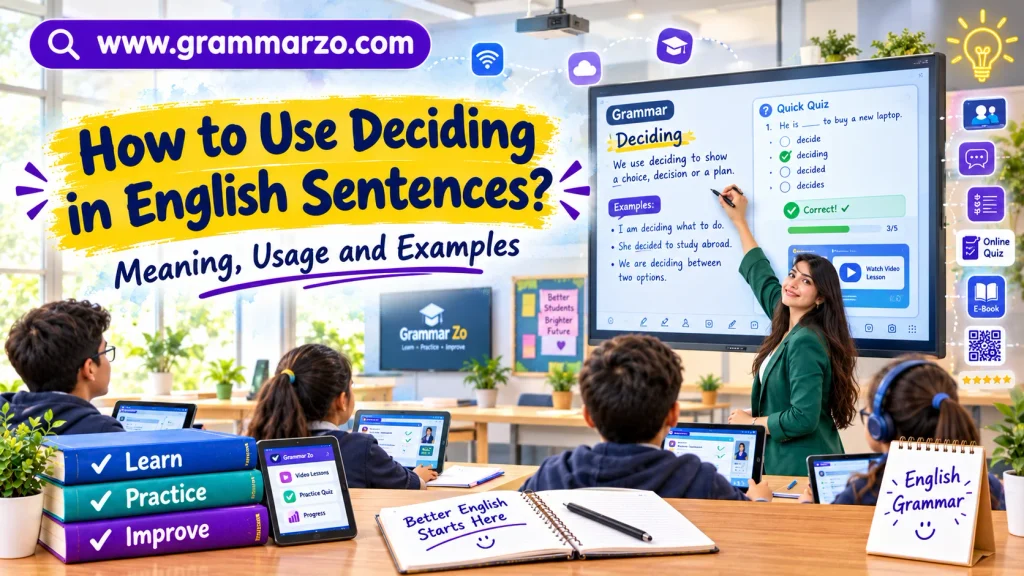
How to Use Deciding in English Sentences
The word can appear in several sentence structures. Learning these patterns will help you use it correctly in conversation and writing.
Using It With Helping Verbs
One common pattern combines the -ing form with a form of the verb “be,” such as am, is, are, was, or were. This construction usually describes an action in progress.
Examples include:
- “I am deciding whether to move abroad.”
- “She is deciding what to wear to the party.”
- “They are deciding which proposal to accept.”
- “We were deciding where to spend our holiday.”
Each example describes an ongoing process rather than simply naming the final result.
Using the Word as a Gerund
A gerund is a verb ending in -ing that functions as a noun. In this form, the word can act as the subject or object of a sentence.
Consider these examples:
- “Choosing a suitable career requires careful thought.”
- “Deciding too quickly can sometimes cause problems.”
- “I dislike making important choices under pressure.”
- “Selecting the right course takes research.”
These sentences describe activities in general rather than focusing on one particular person making a choice at that moment.
Using Whether, What, Which, and Where
Question words help explain the type of choice someone is considering.
- Whether: “I am deciding whether to attend the meeting.”
- What: “He is deciding what to cook for dinner.”
- Which: “They are deciding which candidate to interview.”
- Where: “We are deciding where to celebrate the birthday.”
Use “whether” when considering alternatives or a yes-or-no question. “What” generally introduces a question about a thing or action, while “which” helps identify a selection from a known group. “Where” is useful when the choice concerns a place.

Best Synonyms for Deciding
Several English words have similar meanings, but they do not always work in exactly the same situations. Selecting the right alternative depends on whether you want to emphasize choosing, evaluating, or reaching a conclusion.
Common Alternatives and Their Meanings
| Synonym | Meaning | Example |
|---|---|---|
| Choosing | Picking one option | “I am choosing a new laptop.” |
| Selecting | Picking from available alternatives | “She is selecting a suitable dress.” |
| Determining | Establishing an answer or outcome | “We are determining the final cost.” |
| Considering | Thinking about possibilities | “He is considering another offer.” |
| Evaluating | Examining options carefully | “The team is evaluating the proposals.” |
| Deliberating | Thinking seriously before choosing | “The committee is deliberating over the proposal.” |
| Resolving | Settling a problem or question | “They are resolving the scheduling issue.” |
| Concluding | Reaching a judgment | “She is concluding that the plan needs changes.” |
These words provide useful alternatives when writing about choices. However, their meanings depend on context. Considering an offer does not necessarily mean accepting it, and evaluating options does not guarantee that a final choice has been made.
Choosing vs. Deciding
Choosing usually emphasizes selecting a particular item or option. Deciding can describe the broader process of thinking about possibilities and reaching a conclusion.
For example, “I am choosing a blue shirt” focuses on selecting a color. “I am deciding whether to buy a new shirt” describes the process of determining whether a purchase is necessary.
Both expressions are natural, but the first highlights selection while the second emphasizes the decision itself.
Determining vs. Deciding
Determining often sounds more formal or analytical. It is commonly used when establishing a fact, calculating a result, or identifying what is necessary.
For instance, a manager might be deciding who should lead a project, while an accountant is determining its total cost. One situation involves selecting a person, whereas the other involves establishing a financial figure.
Deciding vs. Decision: Key Differences
Although these words are closely related, they have different grammatical roles. Understanding the distinction helps you avoid mistakes in everyday English.
| Word | Grammatical role | Example |
|---|---|---|
| Decide | Verb | “I need to decide today.” |
| Deciding | -ing verb form or gerund | “I am deciding now.” |
| Decision | Noun | “I made a decision yesterday.” |
| Decided | Past tense or past participle | “We decided to leave.” |
| Decisive | Adjective | “She took decisive action.” |
Common Grammar Mistakes
Incorrect: “I am decision what to buy.”
Correct: “I am deciding what to buy.”
The first sentence uses a noun instead of the required verb form.
Incorrect: “I made a deciding yesterday.”
Correct: “I made a decision yesterday.”
In this example, “decision” names the conclusion reached, so the noun is the appropriate choice.
Another common confusion involves “decisive.” This adjective describes someone or something that demonstrates firmness or produces a clear result. For example, “She is decisive” means she can make choices firmly, whereas “She is deciding” describes an activity currently taking place.
Why Making Choices Can Be Difficult
Some choices require little thought, while others involve uncertainty, competing priorities, or possible consequences. Understanding these challenges can help people approach important decisions more effectively.
Having Too Many Options
A large number of possibilities can make comparisons difficult. Someone choosing a university, for example, may need to examine tuition fees, course quality, location, accommodation, and career opportunities.
Rather than comparing every detail at once, identify the factors that matter most. This approach can narrow the options and make the process easier to manage.
Fear of Making the Wrong Choice
People sometimes delay a decision because they worry about regret. Someone considering a new job may wonder whether the salary, responsibilities, or workplace culture will meet their expectations.
A practical response is to separate known facts from assumptions. Researching the employer, asking relevant questions, and reviewing the advantages and disadvantages can help clarify the situation.
Pressure From Other People
Friends, family members, and colleagues may offer advice about personal choices. Their perspectives can be valuable, but another person’s preferences may not match your own needs.
For example, a student selecting a university should consider family advice while also examining personal interests, academic strengths, finances, and future goals.
Uncertainty About the Future
Some choices involve outcomes that cannot be predicted with complete confidence. A person starting a business, changing careers, or moving to another city may not know exactly how things will turn out.
Instead of waiting for perfect certainty, consider the available evidence, possible risks, and practical alternatives. The aim is to make a reasonable, informed choice rather than guarantee a particular outcome.
Examples in Everyday Conversations
The word appears in discussions about work, education, shopping, relationships, and social plans. These examples show how it fits into natural English.
Work and Education
Professional and academic situations often require people to compare opportunities and responsibilities.
- “Our manager is deciding who will handle the new project.”
- “I am deciding whether to apply for the scholarship.”
- “The team is choosing a deadline for the report.”
- “She spent the weekend considering which course to take.”
- “The committee is determining the next steps.”
Each sentence communicates a different stage of the process, from exploring alternatives to establishing an outcome.
Text Messages and Social Media
In casual communication, people often use short expressions when explaining that they have not settled on a choice.
Examples include:
- “Still deciding what to wear tonight.”
- “I’m choosing between pizza and burgers.”
- “We haven’t picked a meeting place yet.”
- “I’m considering whether to post these pictures.”
- “Can’t decide which photo looks better!”
These expressions are commonly seen in messages and online conversations. On Instagram, Snapchat, or TikTok, someone might use them when comparing outfits, choosing a photograph, or asking friends for suggestions.
The word does not have a separate social media definition. Its ordinary meaning remains the same, although informal messages often leave out words that readers can understand from context.
Relationships and Personal Choices
Personal decisions can involve emotions, expectations, and communication. For example, someone might say, “I am considering whether to move closer to my family.”
Another person might explain, “We are choosing how to divide our responsibilities.” In both situations, the speakers are discussing options that affect their personal lives.
Clear wording helps prevent misunderstandings. Saying “I’m still deciding” shows that a choice remains open, while “I’ve made my decision” indicates that the person has reached a conclusion.
Common Expressions and Phrases
Certain expressions are particularly useful when discussing choices. Learning them can make your sentences more natural and precise.
Deciding Between Two or More Options
The phrase “between two options” is useful when comparing alternatives.
Examples:
- “I am choosing between a laptop and a tablet.”
- “She is deciding between studying abroad and staying home.”
- “We are trying to choose between two possible dates.”
Use this structure when the alternatives are clearly identified.
Deciding on Something
The expression “deciding on” commonly refers to settling on a particular option, such as a name, location, date, or plan.
Examples:
- “Have you settled on a venue?”
- “They are choosing a name for their new business.”
- “We need to agree on a time for the appointment.”
Phrases such as “settling on” and “choosing” can provide natural alternatives, depending on the sentence.
Deciding Whether to Do Something
This construction helps communicate uncertainty about an action.
Examples:
- “He is considering whether to accept the invitation.”
- “I am deciding whether to buy a new computer.”
- “They are discussing whether to postpone the meeting.”
It presents the action as a possibility rather than a confirmed plan.
Making Up Your Mind
“Making up your mind” is an informal expression that means reaching a decision.
For example, “Have you made up your mind about the holiday?” asks whether someone has chosen a destination or made a final choice.
Similarly, “I can’t make up my mind” means the speaker is struggling to choose between alternatives.
Tips for Making Better Decisions
A simple, organized approach can help you manage difficult choices without overcomplicating the process.
Identify Your Main Priorities
Begin by identifying what matters most. Someone purchasing a phone might prioritize battery life, camera quality, storage, or price.
Once the main requirements are clear, it becomes easier to eliminate unsuitable options and focus on realistic alternatives.
Compare the Available Choices
Consider the benefits, drawbacks, costs, and risks associated with each serious option. Try to evaluate them fairly rather than focusing only on the advantages of one and the disadvantages of another.
For a job offer, useful factors may include salary, commute, work schedule, responsibilities, and opportunities for professional growth.
Set a Reasonable Deadline
Some choices require research and discussion, but repeatedly reviewing the same information may not improve the result. A realistic deadline can encourage progress when you already have enough information.
However, high-stakes decisions may require professional advice or additional investigation. The time needed depends on the consequences of the choice.
Accept That Some Uncertainty Remains
Not every outcome can be predicted. You can research alternatives, consider possible risks, and make a thoughtful choice without knowing exactly what will happen.
A sensible approach is to use the information available, select the most suitable option, and adjust your plans if circumstances change.
Frequently Asked Questions
What does deciding mean in simple English?
It means choosing between different options or determining what to do. For example, choosing a meal involves considering possible dishes and selecting one.
Is deciding a verb or a noun?
It is an -ing form of the verb “decide.” It can be part of a verb phrase, as in “I am deciding,” or function as a gerund, as in “Deciding takes time.”
What is another word for deciding?
Choosing, selecting, determining, and deliberating are possible alternatives. The best word depends on whether the sentence emphasizes making a selection, examining possibilities, or reaching a conclusion.
What is the difference between deciding and decision?
Deciding describes the process of making a choice, whereas decision is a noun that refers to the choice itself. For example, “I am deciding now” describes an activity, while “I made a decision” refers to a completed choice.
What is the past tense of decide?
The simple past tense is “decided.” For example, “I decided to stay home.” The past continuous form is “was deciding,” as in “I was deciding what to order.”
Is deciding the same as thinking?
No. Thinking includes many mental activities, such as remembering, imagining, and understanding. Making a decision is more specific because it involves selecting an option or reaching a conclusion.
How do you use deciding in a text message?
You can write “I’m still deciding,” “I’m choosing between the two,” or “I can’t make up my mind.” These expressions sound natural when discussing plans, purchases, outfits, or other everyday choices.
Final Thoughts
Making choices is a normal part of everyday life, from selecting a meal to considering a career change. Understanding the meaning and grammar of deciding, along with alternatives such as choosing, selecting, and determining, helps you express your thoughts more accurately. By choosing words that fit the context, you can communicate whether you are exploring possibilities, comparing alternatives, or sharing a final conclusion.